2026 Voter Guide
At ACCE Action we know winning progressive victories takes organized people and decision-makers who share our values and life experiences. That is why we see every election as an opportunity to move closer toward the California we all deserve. And when we vote together, we can swear in leaders that pledge not to take money from corporations, big real estate or corporate landlords. We can reclaim the money that’s ours from the billionaire class and invest it in people and the services we need to live dignified, safe, and healthy lives. When we vote together, we can provide secure and sustainable income for all, house the unsheltered, give our kids the quality schools they deserve, create free universal healthcare, and so much more.
That’s why ACCE Action leaders have led the charge to create a 2026 Voter Guide that both vets out local and state candidates and weighs in on the local ballot measures we’ll be voting on up and down the state. Check it out!
Paid for by Alliance for Californians for Community Empowerment (ACCE) Action (Nonprofit501(c)(4))
This advertisement was not authorized by a candidate or a committee controlled by a candidate.
Statewide & National
Endorsements

Xavier Becerra
Governor

Jane Kim
Insurance Commissioner

Richard Barrera
Superintendent of Public Instruction

Mai Vang
Congressional District CA-7
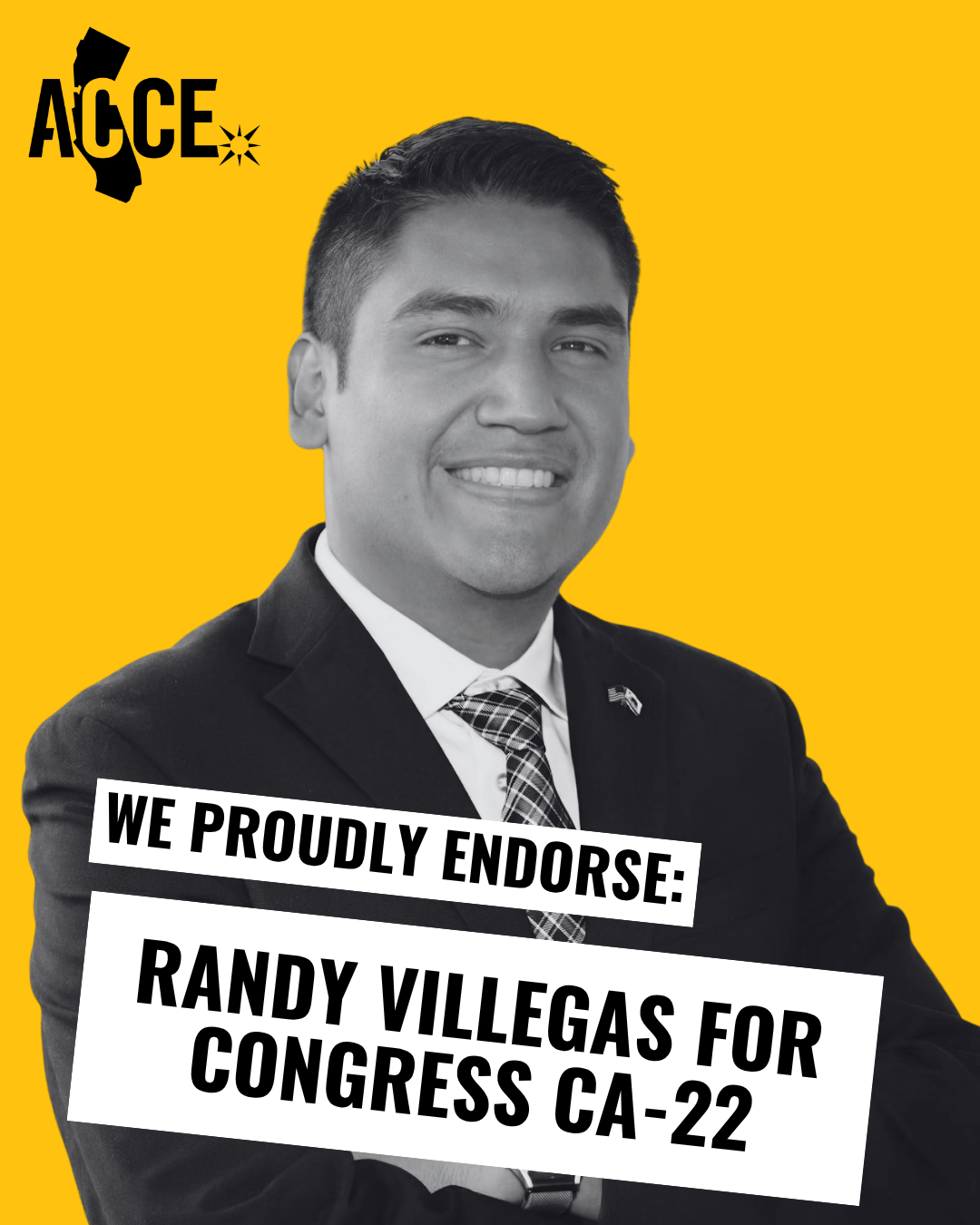
Randy Villegas
Congressional District CA-22

Angela Gonzales-Torres
Congressional District CA-34
Prop 1
Funds Affordable Housing
Yes!
$11 billion housing bond that pays to build affordable homes for veterans, seniors, and working Californians who are being priced out by high housing costs
Prop 2
Expands Rainy Day Fund
Neutral
Raises how much money the state can save in its budget reserve for economic downturns, but sets aside money that could be spent on issues facing California today
Prop 3
Maintains School Funding
Yes!
Makes the existing Millionaire’s tax permanent, protecting billions for our kids’ schools and community colleges
Prop 4
Allows Public Financing of Election Campaigns
Yes!
Lifts the ban on public campaign financing, so everyday people can run for office without depending on corporate and billionaire donors
Prop 5
Reforms the Recall Process
Yes!
Makes recalls fairer: voters first decide whether to remove an official, then choose a replacement in a separate election
Prop 37
Public Funding for Exclusionary Homeownership
No!
Public money for newly constructed homes exclusively accessible to higher income individuals, primarily benefiting builders and developers
Prop 38
Public Medical Research Monday for One Billionaire's Institute
No!
A research bond with rules rigged so half the money, over $4 billion, goes to one billionaire-backed research institute, costing taxpayers more than $12 billion with interest
Prop 39
Makes It Harder to Vote
No!
The "California Voter Suppression Act" forces voters to hand over personal information, even to vote by mail, to fix a problem we don't have
Prop 40
Billionaire Tax
Yes!
Makes California's roughly 250 billionaires pay a one-time 5% tax, so working families don't lose their health care and CalFresh
Prop 41
Blocks Billionaire Tax
No!
A billionaire-backed measure that cancels the Billionaire Tax if it gets more votes, and makes it harder to tax the ultra-rich in the future
Prop 42
Bans Wealth Taxes
No!
A billionaire-backed ban on taxing extreme wealth, killing the Billionaire Tax and blocking any future attempt to make the ultra-rich pay their share
Prop 43
Makes It Harder for Voters to Fund Local Services
No!
Lets a small minority of voters block local taxes on the wealthy, so community wins like LA's Mansion Tax would be nearly impossible to pass in the future
Prop 44
Restricts How Clinics Use Funding
No!
Restricts clinic’s ability to pay for the cost of operating. Could force smaller community clinics to close when healthcare access is already under threat
Prop 45
Cuts Environmental Safety Checks on Development
No!
Business led initiative that would make it easier to build data centers and other polluting projects with little public oversight by gutting the California Environmental Quality Act
Statewide Ballot Measures Rationale
Rationale for “NO on Prop 37”: We support expanding homeownership opportunities, but Prop 37 directs public financing toward a limited group of higher-income buyers purchasing newly constructed homes. The measure does not provide assistance for people buying existing homes and primarily creates a new financing pathway tied to new construction. We believe public resources should be distributed more equitably and focused on making housing affordable and accessible to more Californians, rather than subsidizing a narrow segment of the housing market. Our opposition is rooted in equity and access to housing, not opposition to homebuilding or middle-class homeownership.
Rationale for “NO on Prop 44”: We support ensuring that healthcare dollars reach patients, but Prop 44 imposes a rigid 90% spending requirement on community clinics. As Trump’s Medicaid cuts threaten coverage and clinic funding, clinics need flexibility to stay open and serve patients. We are concerned that a one-size-fits-all spending requirement could undermine clinics’ ability to operate and maintain access to care. Our priority is keeping community clinics open and ensuring patients can continue to access the healthcare they rely on.
Los Angeles
Endorsements

Nithya Raman
Los Angeles Mayor

Estuardo Mazariegos
Los Angeles
City Council
District 9

Marissa Roy
Los Angeles
City Attorney

John Erickson
Senate District 24

Sarah Rascón
Senate District 26

Angela Gonzales-Torres
Congressional District CA-34
Bay Area
Endorsements

Claudia Jimenez
Richmond Mayor

Valarie Bachelor
Oakland Unified School District Board
District 6

Jennifer Brouhard
Oakland Unified School District Board
District 2

Syrak Micael
Berkeley City Council
District 7

Jackie Elward
Assembly District 12
Measure S
San Pablo Rent Control
Yes on S!
Measure EE
Oakland Strong Mayor
Vote Yes!
Sacramento
Endorsements

Dr. Flojaune Cofer
Sacramento County
Board of Supervisors
District 1

Mai Vang
Congressional District CA-7
San Diego
Endorsements

Jose Lopez Eguino
Imperial Beach City Council
District 1

Lidya Morales
San Ysidro School Board
Orange County
Endorsements
